



High-speed train hub eases journeys









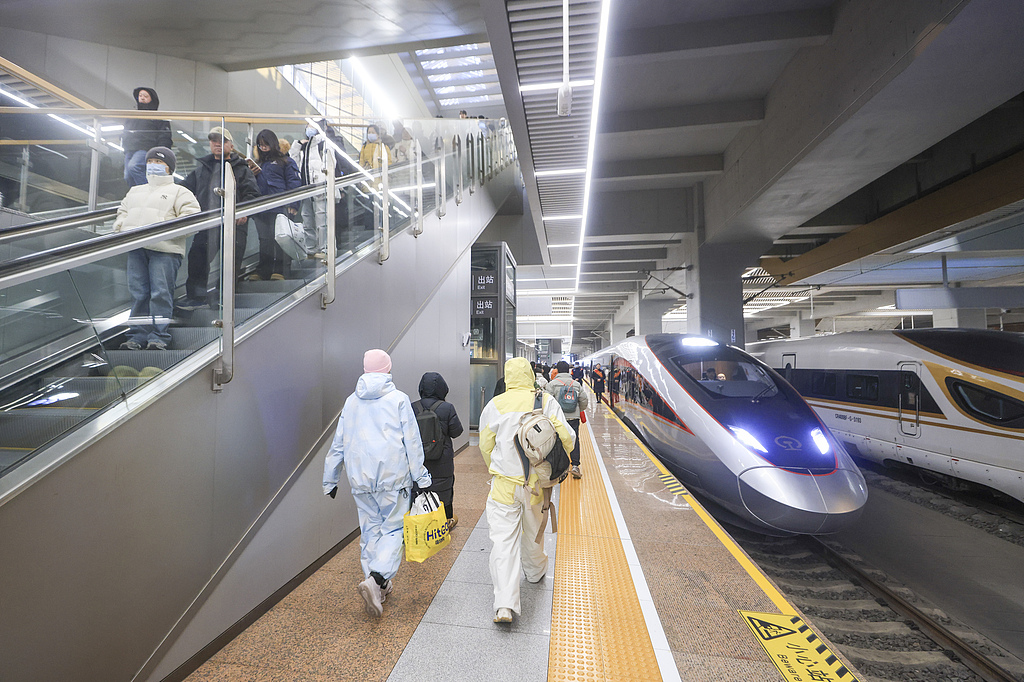
Beijing Chaoyang Railway Station, the high-speed rail gateway linking the capital with North and Northeast China, has seen steady growth in passenger traffic and service capacity since it opened on Jan 22, 2021.
Average daily passenger volume has climbed from about 12,000 to around 30,000, and the station has handled nearly 44 million passenger trips in total, according to station authorities.
"As the starting point of the high-speed rail service connecting Beijing and Harbin, the capital of Heilongjiang province, the station has positioned itself as a key hub serving Northeast China while integrating the Beijing-Tianjin-Hebei region," said Wang Qiang, an official from the station. "We continue to optimize services for travelers."
Liu Guohui, 36, from Chengde in Hebei province, said she was preparing to take a high-speed train home after traveling to Beijing for her daughter's eye checkup and a visit to a hot spring.
Since the opening of Beijing Chaoyang Railway Station, travel time between Chengde and Beijing has been reduced to 49 minutes, down from about four hours on the previous fastest route.
"The station is really convenient," Liu said. "The subway access is especially handy, with the station right at the subway exit."
The first phase of Subway Line 3 opened in 2024, providing a direct underground link to the station.
"It takes just a few minutes to get from the train platforms to the subway station, solving the last-mile problem for passengers," Wang said.
Cao Yan, deputy manager of the station, said Beijing Chaoyang Railway Station serves not only as a transportation hub but also as a critical link for patients seeking urgent medical care in the capital.
Station employees help about 200 passengers requiring special assistance each day, Cao said.
About 50 of them are usually medical patients, many traveling to Beijing for major treatment unavailable near their homes.
In one recent case, a farmer from Chifeng in the Inner Mongolia autonomous region severed a finger while cutting feed for livestock. With only a three-hour window for reattachment surgery at a Beijing hospital, station personnel coordinated a fast-track exit upon the train's arrival, saving crucial minutes on the way to the operating room, Cao said.
Passengers can request assistance through the official 12306 online ticketing platform, she said. Once submitted, the information is shared immediately with train crews and arrival stations to ensure a smooth handover.
The team managing special assistance services at the station has expanded from six to 12 staff members over the past five years.
"As train services increase and passenger numbers grow, so does the proportion of travelers with serious conditions or special needs," Cao said.
"What gives our work meaning is helping make that journey smoother," she added.






- High-speed train hub eases journeys
- Macao university, medical center hold symposium for further cooperation
- Senior Chinese official urges sustained crackdown on cross-border gambling
- Xi signs order to promulgate regulations on military theory work
- China achieves breakthrough in extracting lithium from salt lakes
- Shenzhen logs milestone in green shipping progress