



Severe weather warning issued as cold wave sweeps across country









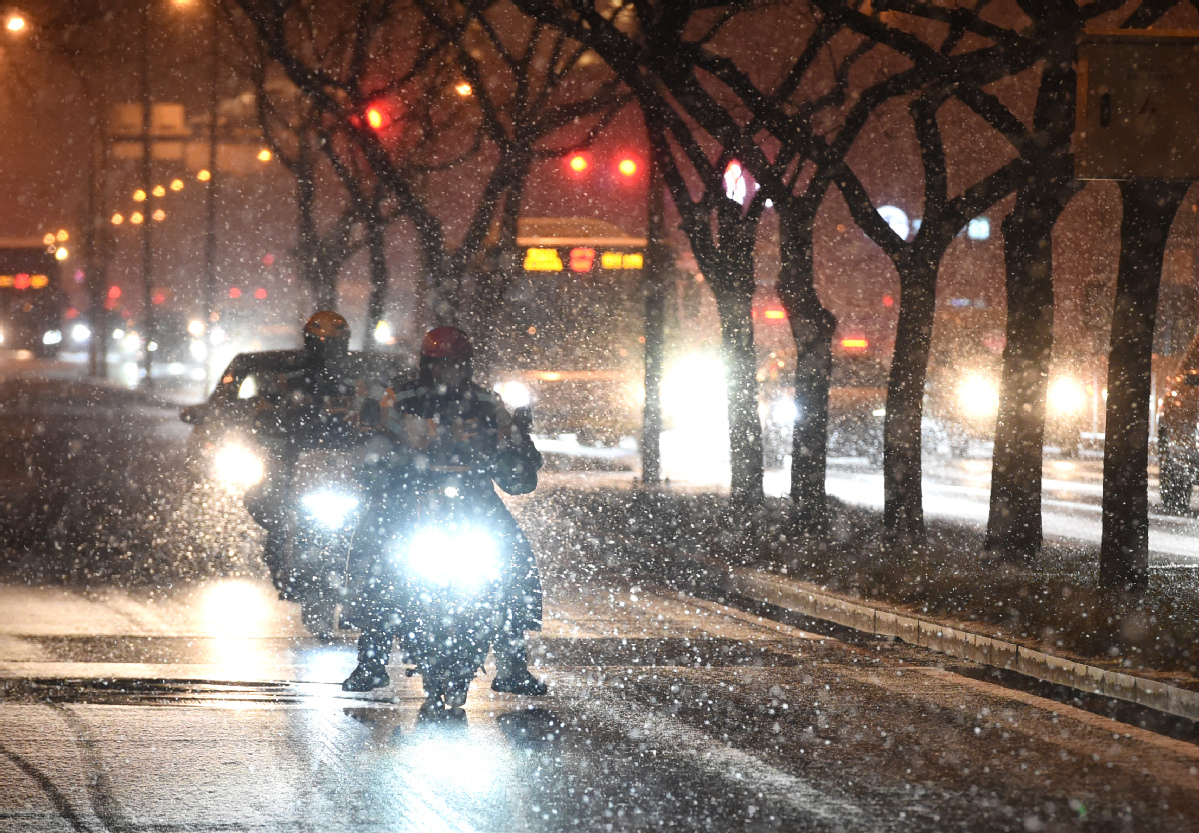
The weather in Beijing trended on social media sites over the weekend as unusually heavy snowfall blanketed the capital in a thick white sheet, even as the National Meteorological Center issued a yellow alert — the third-highest level after red and orange — for cold waves across central, eastern and southern China over the next few days. A yellow alert for freezing conditions and a blue alert for blizzards were issued for some parts of Shaanxi, Henan, Anhui and Hubei provinces.
According to meteorological authorities, the snowfall and accumulation on Saturday and Sunday in Beijing was heavier in the western mountainous areas of the capital.
The weather event was the result of a "return-flow snowfall pattern" in North China, which saw moisture-laden cold air move inland toward Beijing from Bohai Bay.
As the moist air moved over the city's western terrain, clouds formed at temperatures ranging between — 10 C and — 20 C, which is optimal for rapid snowflake formation. As they fell, the snow crystals collided and bonded, creating flakes that appeared to be oversized, meteorologists said.
The snowfall in Beijing occurred as a strong cold wave swept much of China. The National Meteorological Center said that from Sunday to Wednesday, the cold wave will bring strong winds, sharp drops in temperatures and widespread rain and snow.
The center issued a yellow cold wave alert on Sunday, warning that temperatures in central and eastern China will drop 6 C to 12 C during the period, with some areas experiencing declines of 16 C or more. The current severe winter condition is expected to peak on Monday.
On Sunday evening, the national disaster prevention, reduction and relief commission activated a Level IV emergency response — the lowest in its four-tier system — to address the rising risk of low temperature-, snow — and ice-related disasters in Anhui, Henan, Hunan and Guizhou provinces. A working group previously dispatched to Henan will continue assisting local response efforts, while additional working groups have been sent to Hunan and Guizhou to provide on-site guidance.
In Altay prefecture of northern Xinjiang Uygur autonomous region, the minimum temperature in Qinghe county plunged to — 40.8 C over the weekend.
Gui Jin, a homestay host in Hemu village in Altay, said the temperature there was — 38 C on Saturday. "I'd rather be in Antarctica," he joked, where he said the lowest temperature was around — 32 C on the same day.
Hu Xiao, an analyst with the China Meteorological Administration, said the current cold wave is bringing about dramatic changes in temperatures.
Earlier this month, the traditionally coldest period of winter, the weather was unusually warm nationwide, making it the third warmest on record. Now the situation has changed. "People will feel as if the weather has suddenly become frigid," Hu said.
The cold wave is moving relatively slowly and is accompanied by ample moisture. Snowfall began in North China on Saturday, intensified in Henan province and Shandong province on Sunday, and is expected to be most widespread and strongest on Monday.
The weather event also marks the first widespread freezing rain of this winter. From Monday to Wednesday, sleet is expected in parts of Hubei, Hunan and Guizhou provinces and in Chongqing, with Hunan and Guizhou expected to face the brunt of it.
Wang Xiangxi, minister of emergency management, called for enhanced coordination and preparedness to address risks posed by low temperatures, snow, ice and freezing rain.
Officials warned that the weather event would be the largest of its kind so far this year, with complex precipitation types and elevated disaster risks in some regions. With the approach of the Spring Festival holiday and increased travel volume, they emphasized the need to be ready for worst-case scenarios.
In Hubei, China Railway Wuhan Bureau activated emergency plans to safeguard rail operations, conducting advance risk assessments about the effect of low temperatures on key equipment such as rail switches and tracks.
Crew members were deployed to remove ice and snow from tracks and carry out preventive maintenance to ensure the safety and smooth operation of railway services, the bureau said.
In Gansu province, protective steps have been taken to reduce weather-related losses to crops. Local governments have been urged to take windproof measures for construction sites, billboards and livestock enclosures.
Energy authorities were also making efforts to ensure stable operation of electricity, gas and heating systems as the cold wave continued to affect large parts of the country.
Liu Kun in Wuhan and Ma Jingna in Lanzhou contributed to this story.






- Severe weather warning issued as cold wave sweeps across country
- Steel plant explosion kills 2, 8 missing
- Sanya rises as magnet for Russian tourists
- Blueprint seen as a boon for entire world
- Authorities urged to prepare as cold wave hits Central China
- Explosion at Baotou steel plant kills 2, 5 missing