



Paid study spaces gaining popularity among China's dream-seeking youth









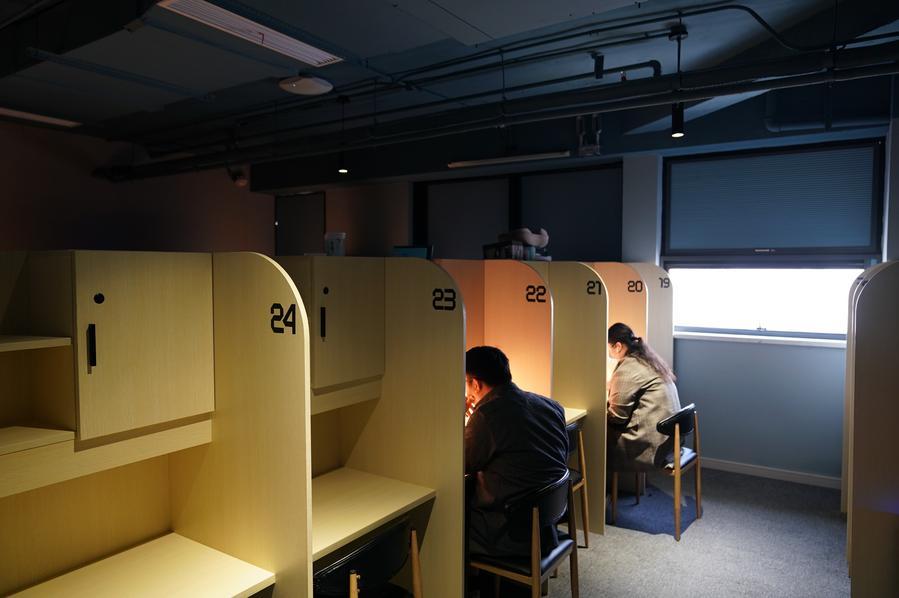
BEIJING -- As the clock neared 10 pm in Beijing's Changping district, the lights at Chenxi Study Room were still shining brightly. Among rows of focused students, 24-year-old Lin Guoguo was deep in her books, preparing for her second attempt at the competitive graduate entrance exams.
"I came here just for a quiet spot, but the atmosphere is incredible," she said. "Seeing everyone so dedicated fuels my own drive."
This scene captures the essence of the rapidly growing paid study room industry. More than just quiet spaces, these venues have become sanctuaries for many young Chinese striving to upgrade their skills, pass make-or-break exams and navigate an increasingly competitive job market.
Paid study rooms, often referred to as "self-study rooms," offer meticulously designed environments featuring well-lit open areas, sound-proofed cubicles, private booths and rest zones equipped with printers, microwaves, free coffee and snacks.
The pricing system is usually designed flexibly to suit various needs, offering options from hourly rates to annual memberships.
At the forefront is Zhongxiang Study Room chain brand. Established in October 2023 in North China's Hebei province, it has rapidly expanded to over 60 directly operated venues and more than 100 franchise outlets.
"Our study rooms serve around 140,000 registered customers, with annual revenue of about 10 million yuan ($1.4 million)," company director Meng Yulong said, while adding that over half of their customers are preparing for postgraduate or civil service exams.
For many young Chinese, home is too familiar and distracting for deep study, while cafes and libraries can be noisy or crowded. Paid study rooms fill this gap by providing not only a quiet space but also a powerful sense of shared purpose. "When you see everyone around you studying, that atmosphere is really contagious," said Wang Pan at Chenxi Study Room.
At this venue, students adhere to an unwritten code of conduct, which entails taking phone calls outside, cleaning up after having snacks and maintaining an environment of mutual respect. Bulletin boards are filled with encouraging notes and success stories from those who have "made it."
According to Meng Yulong, this industry took off around 2018, and it is now estimated to have roughly 100,000 venues across China. With an average of 50 seats per room and monthly passes costing about 400 yuan, the industry represents a market worth over 10 billion yuan annually.
Yet beyond the economics, these spaces address a deeper social need. Many young people are proactively investing in their future, whether by seeking further education or advancing professional skills.
In Tianjin municipality in North China, a 29-year-old who prefers to be called A Lan recently left a high-pressure job at a tech giant, opting instead to pursue a civil service post and prepare for the required exams at a study room.
"I just want a stable life now. This space gives me the peacefulness to rebuild," he explained.
Another interviewee, Xiao Peng, is preparing to take the graduate entrance exams. He has decided to switch from bioengineering to computer science for better job prospects.
"The pressure is intense, but my mind is made up," he said.
Notably, paid study rooms are also evolving to address this growing need. "We aim to shift from merely selling seats to providing integrated services, even offering courses," Meng said, adding that the vision is to transform study rooms into learning hubs that support the young through both content and community, potentially making basic access free in the future.
Experts point to the larger significance. "These spaces reflect young people's self-driven motivation and adaptability," said Zhang Zhihong, from Nankai University in Tianjin.
"They highlight a demand for environments that foster concentration and personal growth -- a need that both the market and public services should meet," said Zhang.
The growing popularity of paid study rooms also reflects the country's broad effort to fostering a culture of reading and lifelong learning.
In recent years, from upgraded public libraries and expanded community reading spaces to the rise of paid study rooms, Chinese society has been building a multi-level network of learning environments.
This effort aligns with the recently released recommendations for formulating the next five-year plan for national economic and social development, which call for further efforts to foster "a culture of reading."
As night deepened, the lights at Chenxi Study Room remained on. Inside, a quiet stillness prevailed, broken only by the soft rustle of pages and illuminated by the gentle glow of laptop screens.
"Here, hard work feels like a shared journey, and that makes all the difference," said Lin Guoguo.






- Paid study spaces gaining popularity among China's dream-seeking youth
- Mainland slams DPP for selling out Taiwan to please external forces
- Hunan doctor's rape case retrial reinstates 8-year sentence
- Underage assault in Inner Mongolia: four detained, one gets correctional education
- China experiences brief warm spell before cold snap returns
- China selects 440 products in latest medical procurement round to ease patient costs