


A learning curve
University court in Fujian hosts EASL's first foray into the Chinese mainland









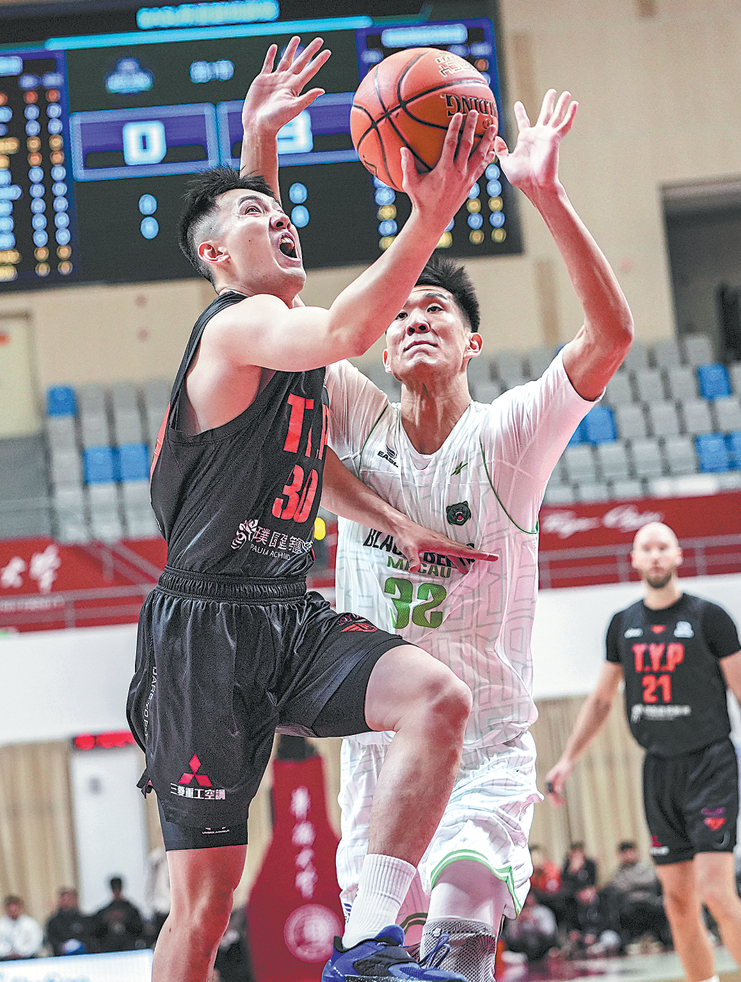
When the Macau Black Bears stepped onto the court at Huaqiao University's gymnasium in Quanzhou, Fujian province, on Sunday afternoon, the scoreboard told only part of the story.
The Black Bears lost 95–83 to the Taoyuan Pauian Pilots from Chinese Taipei in an East Asia Super League (EASL) group-stage game. Yet the more consequential result lay in where — and how — the game was played.
That the contest unfolded on a university campus was not incidental. It was central to what the league, and the team, was testing.
For the first time, Asia's premier professional basketball league staged an official game in the Chinese mainland. And, rather than choosing a commercial arena, the EASL placed that experiment inside a college gym — where professional players, student-athletes, and campus life briefly converged.
For fans on the Chinese mainland, it was a rare chance to watch elite Asian club basketball up close. For the league, it was a cautious first step into a crucial market. And for the players of Huaqiao University sharing minutes with professionals, it offered a glimpse of a future usually separated by years.
The game marked the EASL's Chinese mainland debut after several seasons of expansion across Asia. This year's league features 12 teams from seven countries and regions: three from Japan, three from Chinese Taipei, two from South Korea, and one each from China's Hong Kong and Macao special administrative regions, the Philippines, and Mongolia. The teams are divided into three groups, with the top two from each group advancing to the playoffs to be held in Macao in March.
League CEO Henry Kerins said bringing an EASL game to the Chinese mainland was both symbolic and practical.
"For us, it's partly a learning experience," Kerins said. "But it's also something we want to give to our Chinese fans who have supported us for so long — it's the first real live EASL event in the Chinese mainland."
The league plans to expand to 16 teams next season, and Kerins said he hopes Chinese Basketball Association (CBA) teams will eventually rejoin the competition. Zhejiang Lions and Liaoning Flying Leopards have both appeared in previous editions of the EASL, but scheduling remains the primary obstacle.
"We first respect the domestic league schedules of every country and region," Kerins said. "Within that framework, we hope there will be opportunities to invite CBA teams."
Even without CBA participation this season, the Chinese mainland remains central to the league's strategy. EASL games are broadcast on platforms such as Migu and Tencent, and Kerins said fans from the Chinese mainland account for around 40 percent of the league's total audience.
"Whether or not CBA teams participate, (the Chinese mainland) is extremely important to us," he said. "Basketball fans (there) want to see more high-level basketball."
Kerins views the EASL not only as a competition, but as a platform to showcase the diversity of Asian basketball styles — from the Philippines' fast-paced, guard-heavy game, to South Korea's perimeter-oriented approach. He said teams often return to their domestic leagues stronger after EASL competition.
"There's an impact on teams, players, and coaches," he said. "Overall, it strengthens the ecosystem."
With a relatively limited number of games each season, the league places particular emphasis on the overall event experience. Beyond basketball, the EASL finals often include concerts and, this year, will host a professional sports summit.
Venue selection, Kerins said, prioritizes quality arenas and cities with a strong appetite for both sports and entertainment. He pointed to Japan as a reference point, noting that for one team in Okinawa, 53 percent of tickets are purchased by women.
"They offered a product that's not just basketball," Kerins said. "It's healthy food, a welcoming arena, and an experience where people can spend three hours." That broader approach also ties into tourism. During last year's finals in Macao, visiting fans stayed an average of four days, often traveling with families. Even before Macao had its own EASL team, the arena was full.
"The type of tourists who follow EASL are very valuable," Kerins said. "They tend to be higher-income and want to experience the host cities."
With 26 broadcast partners across Asia, he added that the league also serves as a vehicle for promoting host cities to regional audiences.