


US' Greenland push rattles NATO alliance, experts say
Security arrangements face scrutiny after territorial tug-of-war










Greenland — the world's biggest island — covers over 2.16 million square kilometers, is strategically located between the Arctic Ocean and the North Atlantic Ocean, and has a small population of around 57,000 people.
The majority of the island is located in the Arctic Circle, and its nearest neighbors are Canada and Iceland.
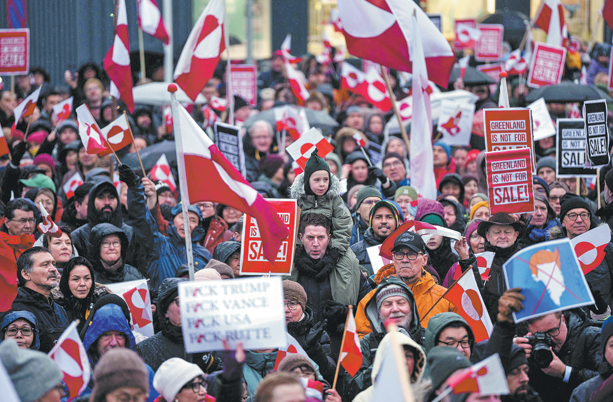
The large, icy island, roughly six times the size of Germany, has been embroiled in an even bigger international diplomatic row after US President Donald Trump ramped up his desire this month to place the Danish territory under the United States' control.
Trump said his quest to acquire the territory, known to be rich in natural resources, including critical rare earth minerals, was for "US national security" reasons, claiming on Jan 9 that it was "covered with Russian and Chinese ships all over the place".
Foreign Ministry spokesman Guo Jiakun said at a news briefing the "so-called China threat" is baseless, adding "China always believes that the purposes and principles of the UN Charter should be upheld when handling relations between countries".
After his meeting with NATO Secretary-General Mark Rutte in Davos, Switzerland, on Wednesday, Trump posted on Truth Social that he had forged the "framework of a future deal with respect to Greenland and, in fact, the entire Arctic Region. This solution, if consummated, will be a great one for the United States of America, and all NATO Nations".
Yet, the mere idea that the US, a key ally, would even consider a takeover of the territory of a sovereign state — possibly by force until Trump ruled it out in his speech before the World Economic Forum in Davos — stunned European nations.
It did not just ruffle European leaders' feathers; it rattled NATO — the transatlantic defense alliance that dates back nearly 80 years — as many of the European Union member states still rely heavily on the US for security.
"If gained through coercion, the impact would (have been) devastating for the United States and the rest of the world," Michael A. Allen, a political science professor at the School of Public Service Boise State University in Idaho, told China Daily.
"It is hard to imagine a scenario in which a US-led NATO would continue to exist, and this powerful, successful security framework could evaporate overnight. Other allies would question the US as a leader going forward; being an ally no longer protects one's territorial integrity from the US."
Denmark's Prime Minister Mette Frederiksen stood firm, even after Trump's apparent backdown at Davos. "We can negotiate on everything political; security, investments, economy. But we cannot negotiate on our sovereignty," she said.
European leaders held an emergency summit in Brussels on Thursday, to discuss Greenland, the alliance and EU-US ties.
"Trans-Atlantic relations have definitely taken a big blow over the last week," the EU's foreign policy chief, Kaja Kallas, said as she arrived at the meeting.
French President Emmanuel Macron said: "Things are quietening down and we should welcome that. We remain extremely vigilant and ready to use the instruments at our disposal should we find ourselves the target of threats again."
The North Atlantic Treaty Organization was formed on April 4, 1949 to provide collective security for members. It aimed to prevent Soviet expansion after World War II. Article 5 of the treaty states if one member state is attacked, all are.
European nations did, however, breathe a sigh of relief after Trump called off his threat to impose a 10 percent US tariff on Feb 1 on the eight European nations that opposed his plan to take over Greenland.
The levies would have hit the United Kingdom, Denmark, Norway, Sweden, France, Germany, the Netherlands and Finland. The threat of the tariff rising to 25 percent from June 1, was also canceled.
UK political onlookers said that one other notable EU-US dynamic shifted over Greenland.
Several world leaders, including Macron, British Prime Minister Keir Starmer and Canadian Prime Minister Mark Carney, were uncharacteristically forthright in criticizing the US' push to acquire Greenland.





