



New milestone for offshore turbine tech









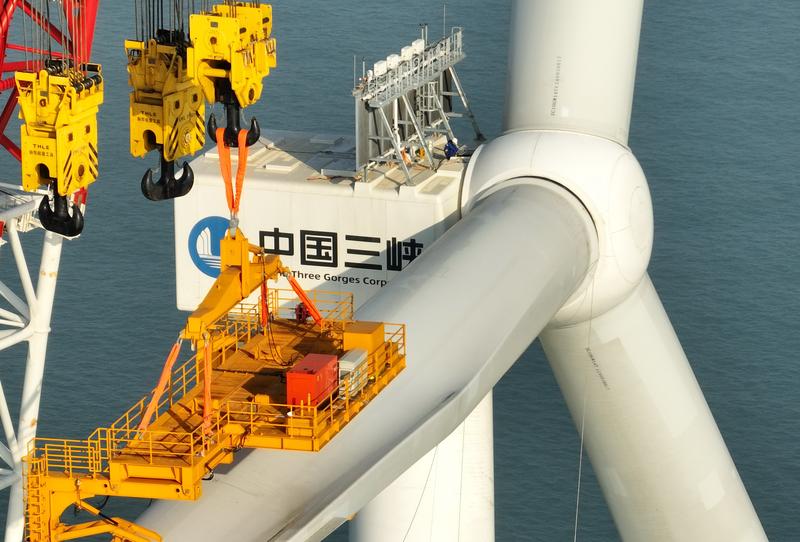
The nation's successful installation of the world's first 20-megawatt offshore wind turbine has redefined the technological frontier for renewable energy, signaling that the era of ultra-large-scale maritime power has arrived, said industry experts.
As part of a national key research and development program, the project, located in the waters off East China's Fujian province, has all its major components independently developed and produced in China, according to its operator China Three Gorges Corp.
Located more than 30 kilometers off the coast of Fujian province in depths exceeding 40 meters, the installation proves that massive-scale wind power is now viable in harsh, far-shore environments, said CTG.
Industry analysts note that by pushing single-unit capacity to such heights, China is effectively circumventing the logistic bottlenecks that have stalled offshore wind projects in Europe and North America.
The successful installation signals a qualitative shift in China's offshore energy strategy, transitioning from nearshore exploration to the deployment of high-capacity, efficient units in deeper and more remote waters, said Lin Boqiang, director of the China Center for Energy Economics Research at Xiamen University.
The project establishes new benchmarks for global maritime engineering and highlights China's pivotal role as the world's leading energy producer and consumer, he said.
By aggressively scaling wind and solar infrastructure, the nation is increasingly defining the trajectory of both domestic and international green energy transitions, he said.
According to Peng Peng, secretary-general of the China New Energy Investment and Financing Alliance, an industry group, deep-sea and far-offshore wind projects currently continue to face challenges related to relatively high development and subsequent operation and maintenance costs.
If offshore wind can be integrated with other industrial sectors, it will enhance the economic viability of the industry and inject greater vitality into the broader marine economy, she said.
During the 15th Five-Year Plan period (2026-30), the country aims for annual new wind power installations of no less than 120 gigawatts, with offshore wind accounting for at least 15 GW annually.
According to statistics from the National Energy Administration, China's cumulative wind power installed capacity reached 520 GW by 2024, marking a 147.62 percent increase from 2019. Annual new installations between 2020 and 2024 consistently exceeded 60 GW, it said.
According to the Energy Economics Institute of the China National Offshore Oil Corp, the country's largest offshore driller, offshore areas of China will become a major energy growth driver in the country for years to come.
Historically, the cost of subsea foundations and the difficulty of maritime logistics in deep water have made such projects prohibitively expensive. However, this 20-MW unit features a breakthrough in lightweight engineering, with its weight-per-megawatt ratio reduced by more than 20 percent compared to current industry averages.
This mass reduction allows for significantly more affordable underwater foundations, lowering the total capital expenditure required for deep-sea installations, said CTG.
With a rotor diameter of 300 meters, the turbine's swept area covers approximately 66,000 square meters, equivalent to nearly 10 standard football fields. The installation served as a live demonstration of China's advanced maritime engineering capabilities, said CTG.
To manage the immense risks of working at extreme heights in complex sea states, crews utilized a fourth-generation wind power installation vessel with a 2,000-metric-ton lifting capacity.
The operation relied on high-precision intelligent positioning systems to ensure the giant blades could be connected to the structure with millimeter-level accuracy.