

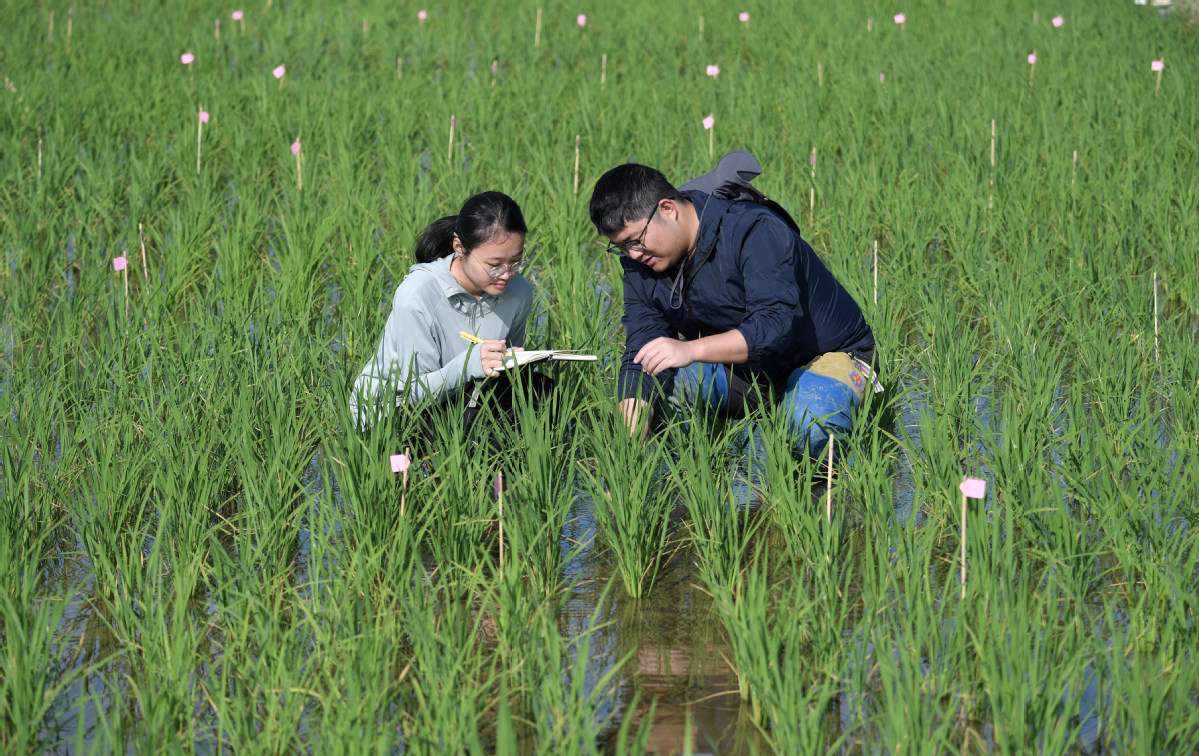
AI cracks the code for faster, better crops
Hainan's Fan project boosts food security, helps meet national goals










Nationwide effort
Agricultural innovation is also advancing at other Chinese institutions and research bodies.
At the China National Seed Group, researchers use an AI-powered, cloud-based system to remotely monitor fields and collect real-time data on crop health, enabling prompt intervention.
The Chinese Academy of Agricultural Sciences is also exploring the transition from experience-driven to data-driven breeding.
In the past, breeders tested thousands of combinations to find a single superior hybrid. Now, AI-powered genomic analysis predicts high-yield combinations before field trials begin, said Li Huihui, deputy director of the National Nanfan Research Institute of the Chinese Academy of Agricultural Sciences.
Li Jiayang, an academician at the Chinese Academy of Sciences, spoke highly of the concept of "intelligent creation of intelligent varieties", underscoring the potential of integrating AI, biotechnology and information technology to develop crops that autonomously adapt to environmental challenges.
Despite these advancements, challenges remain.
"Our country's total number of research papers in the seed field has surpassed that of the United States," said Wan Jianmin, an academician of the Chinese Academy of Engineering and former vice-president of the Chinese Academy of Agricultural Sciences.
"However, the connection between basic research and breeding application is not tight enough, and the innovation capacity in breeding theory and methodology is relatively weak," Wan said.
Wan also highlighted gaps in frontier biotechnology.
"Our R&D capability and level in biotechnology still lag noticeably behind the US. This is evident in core patents. While China's core patent quantity ranks second globally, the US holds far more high-value patents and controls the majority of core biotechnology patents," he added.
China's smart breeding sector also trails global seed giants in terms of data-sharing infrastructure and commercialization, said Qian Qian, another Chinese Academy of Sciences academician.
"Given the complexity of crop traits, understanding the relationship between genes and traits requires computational power and advanced algorithms," Qian said.
"Accelerating the development of high-yield, high-quality and climate-resilient 'super varieties' is crucial," Qian said, calling for interdisciplinary collaboration among breeding institutions, AI researchers and agribusinesses, to drive innovations in smart breeding.