



Tianjin bookstore binds readers' interests together









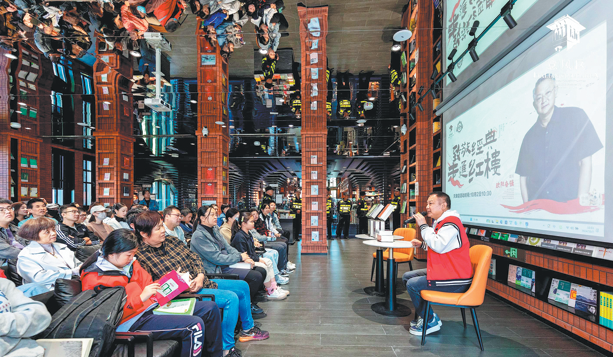
A flagship bookstore in Tianjin is fast becoming a must-visit in the port city, as crowds flock there not just for the books, but for the stylish atmosphere, stunning architecture, and for a place to socialize and attend events.
Since opening a year ago, Tianjin Zhongshuge bookstore has welcomed more than 2 million visitors through its doors. Almost half of its revenue comes from non-book sales, and the venue has hosted over 100 cultural activities, from author talks to reader meet-ups, according to the store's deputy manager.
"The store is evolving into a cultural hub rather than a traditional retail space. We want to offer aesthetic enjoyment, a sense of community and cultural identity," said deputy manager Lu Ying.
For many visitors, the experience begins with the design. "Walking into Zhongshuge is like walking into Hogwarts," said Li Yuanyuan, a tourist visiting Tianjin.
She pointed to mirrored walls and a spiral staircase framed by red brick, saying the space felt "like entering a world of magic".
Tianjin Zhongshuge was named one of the World's Most Beautiful Emporiums by the Prix Versailles 2025, and also won dual honors from the Architizer A+Awards, securing both the Jury and Popular Choice prizes.
Ding Hui, head of the technology and quality department at China Railway Construction Engineering Group Third Company, said the interior uses minimalist metal materials to create strong contrasts in texture and temperature.
Mirrors, arches and what he described as an "endless sea of books" help dissolve physical boundaries, creating an immersive reading environment.
The chain bookstore was founded in 2013, Lu said, adding that it adheres to the philosophy of being a "chain without replication". This approach involves integrating local characteristics to establish each store as a city cultural landmark.
For regular readers, the appeal goes beyond aesthetics. Ruby, a reader from South Africa who works in Tianjin, said she visits the store frequently. "I love fantasy books, and there's always something I want to read," she said. "Sometimes I meet other book lovers here and make new friends."
To engage its growing audience, the bookstore runs a steady program of public events. Its "Fall for Reading, Discover Vibrant Tianjin" initiative includes new book launches, classic literature discussions, children's picture-book sessions and popular science talks, many of which draw a full house.
The revival of such spaces comes as physical bookstores face mounting pressure from e-commerce and digital reading platforms. Observers say their renewed popularity reflects a growing demand for cultural and social experiences that cannot be replicated online.
Similar experiments can be seen elsewhere in China. In the coastal city of Xiamen, Fujian province, Once Bookstore blends literature, coffee and art with seaside concerts and community events. In Qingdao, Shandong province, a local Xinhua Bookstore has introduced a Youth Night School and cultural markets, repositioning itself as a social and learning space for young people.
"A bookstore is not just a retail space for books; it's a city landmark and a hub for communication and cultural exchange," said Li Guozhong, head of the publicity department of Tianjin's Hebei district.
She said their role is important in enriching the city's cultural life and fostering a culture of reading among the public.
That idea was reflected in the 2025 Haihe Reading Season, held in October and centered on Zhongshuge. The festival brought together publishers from across China and combined books with traditional crafts, food and interactive workshops, including demonstrations of movable-type printing.
Li compared the trend to bookstores such as New York's Strand and Japan's Tsutaya Books. While the models differ, she said, the logic is similar: moving beyond book sales to connect people with culture and community.
She added that turning a popular destination into a lasting cultural institution remains a challenge. How to keep pace with changing tastes, avoid aesthetic fatigue and balance commercial growth with cultural value, are questions that physical bookstores will continue to face.
Zhang Haoyu and Liu Zhenyi contributed to this story.





Today's Top News
- Washington turning back the clock with gunboat economics and resources plunder
- US' troubling retreat to unilateralism: China Daily editorial
- Xi chairs CPC leadership meeting to hear work reports of state institutions
- Xi congratulates Thongloun on election as general secretary of 12th Central Committee of Lao People's Revolutionary Party
- China brings back alleged gambling, fraud kingpin from Cambodia
- US quits 66 intl organizations under Trump's order