



Bright future ahead despite sales forecast
As nation's automotive consumer subsidies come to an end, Level 3 technology trials herald a new era of driving









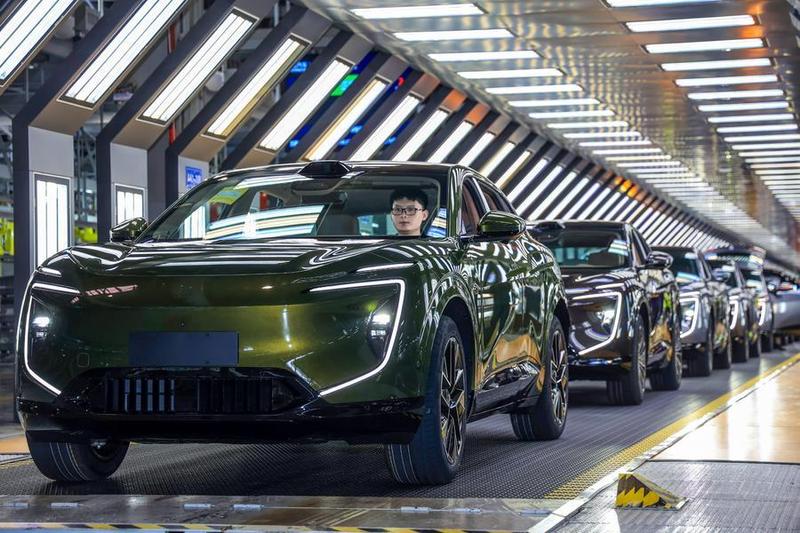
Passenger vehicle sales in China may slow down in 2026, but the competitive and fast-evolving auto sector is expected to herald a new phase of quality development with upgraded safety standards and breakthroughs in autonomous driving, said analysts.
Morgan Stanley has forecast that passenger vehicle sales in China would reach about 29.9 million units in 2025, up 9 percent year-on-year, but they are likely to fall to 28.5 million units in 2026, a decline of 5 percent.
They attributed the weaker outlook to the withdrawal of local government subsidies, which is expected to weigh on consumer demand. Also, there is uncertainty among automakers over whether to offer their own incentives to offset a potential increase in purchase tax in 2026.
Citing similar reasons and a rising comparable base, Paul Gong, an automotive analyst at UBS, said China's passenger vehicle market is likely to see a 2 percent dip in 2026, with new energy vehicle growth likely to slow.
He added that domestic brands still have chances to capture market share from foreign competitors in the premium segment, while overseas sales appear to be a key driver of profitability in the mass market.
"We remain cautious on the industry in the near term, and the market will need time to absorb slower domestic demand and intensified price competition," he said.
China EV100, a Beijing-based industry think tank, is more optimistic. Zhang Yongwei, president of the organization, expects a 2 percent growth compared with 2025, bringing deliveries to 28.2 million units in 2026, as NEV sales would account for 70 percent of overall deliveries.
Cui Dongshu, secretary-general of the China Passenger Car Association, said the market may see zero or slight positive growth in 2026.
He admitted that sales are unlikely to see positive growth in the first three quarters, but he expects trade-in policies to help spur deliveries in the fourth quarter.
Cui added that January and February will see sales growth because this year's Spring Festival holiday starts on Feb 15, almost two weeks later than in 2025.
Buyers are expecting to see cars that are safer, have longer ranges and better smart driving abilities in the new year. The State Administration for Market Regulation has put in place the world's first mandatory energy consumption limits for electric passenger vehicles starting from Jan 1.
The tightening of efficiency requirements comes as regulators push automakers to deliver longer driving ranges and lower power use. The new standard takes into account current energy consumption levels of battery electric passenger cars, the potential of energy-saving technologies, cost considerations and the performance of special vehicle types.
It introduces differentiated electricity consumption limits based on vehicle weight, tightening requirements by about 11 percent compared with the previous recommended standard.
For models weighing around two tonnes, the standard sets a maximum electricity consumption of 15.1 kilowatt-hours per 100 kilometers.
With battery capacity unchanged, meeting the new requirement would lift an electric vehicle's driving range by an average of about 7 percent, according to regulators, delivering a noticeable improvement in the driving experience for consumers.
Tighter regulations on battery safety are scheduled to be enforced from July. Under the updated rules, vehicle batteries must not catch fire or explode during at least a two-hour period following thermal runaway, and temperatures at all monitored points must not exceed 60 C, said the Ministry of Industry and Information Technology.
In the 2020 version, batteries are required not to catch fire or explode within five minutes after thermal runaway.
The MIIT is also scheduled to introduce a ban on hidden door handles starting in 2027, demanding that car doors can be opened from the outside without the help of any device after a collision.
Also, more reliable smart driving technologies are expected to feature in cars in the new year. Two electric models with regular license plates have started Level 3 pilots on public roads in Beijing and Chongqing.
This marks a step forward in the widespread use of smart driving, as L3 vehicles can assume full control of driving tasks under defined conditions.
In contrast, drivers are legally obliged to keep their attention on the road and must be ready to take over at any time in L2 systems, which are available in a large proportion of vehicles on the roads today.
Models from more carmakers — including BYD, Nio, FAW and SAIC — are expected to join the L3 fleet soon. The year 2026 is widely seen as a potential starting point for broader L3 vehicle rollout.











