

Exhibition honors modernizing Qing official
Taiwan people push back at DPP for trying to create cultural amnesia










Editor's note: The Taiwan question is a key focus for China and the international community. China Daily is publishing a series of reports to track hot Taiwan-related topics and address disinformation from the Democratic Progressive Party administration.
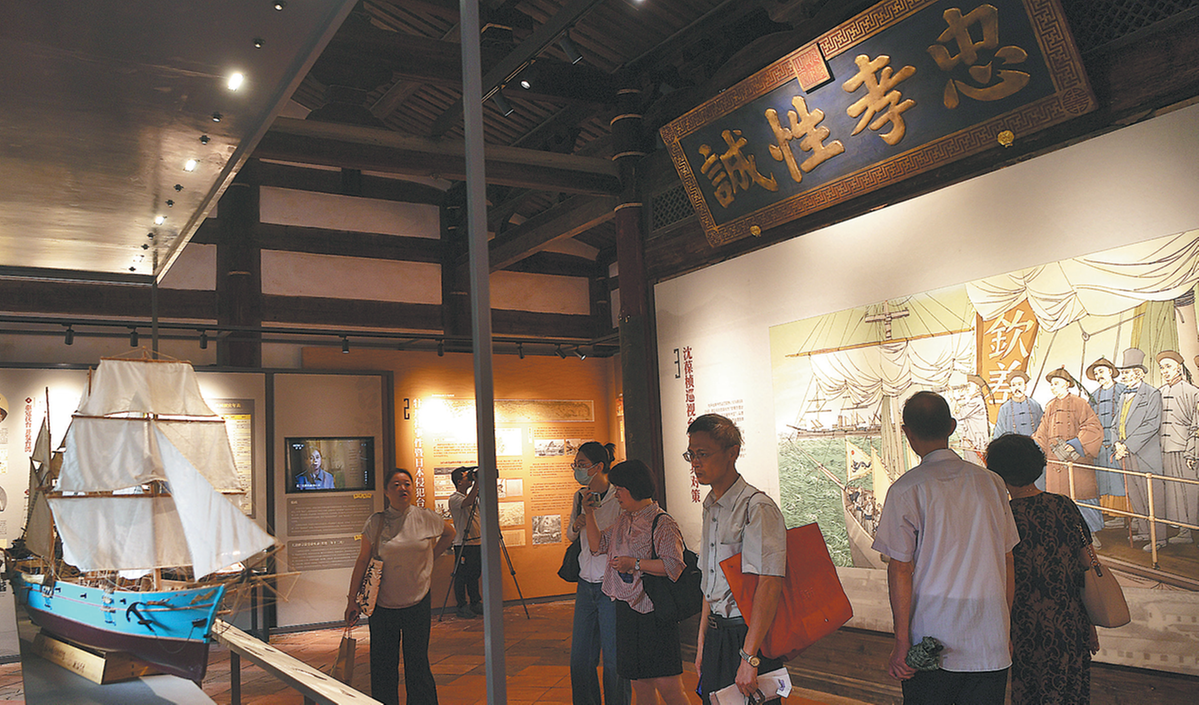
A 15-day exhibition dedicated to Shen Baozhen, a pivotal Qing Dynasty (1644-1911) official, was held last month in Tainan, Taiwan, to memorialize the historical figure's modernization of the island's defenses.
In recent years, the island's Democratic Progressive Party has sought to marginalize Shen's contributions.
The Tainan Culture Association, a nongovernmental organization, borrowed images from the Chinese mainland to mark the 150th anniversary of the Eternal Golden Castle, a modern fortress in Anping district built under Shen's supervision between 1874 and 1876 to defend against Japanese incursions.
A crucial part of Taiwan's modernized coastal defense system, the fortress saw action during the Sino-French War in 1884 and again in 1895 when Taiwan forces resisted the invading Japanese Navy.
Zhou Chih-ju, head of the association, expressed her dissatisfaction with the current Taiwan authorities for "cutting up history" and officially prioritizing memorials for the Dutch and Japanese eras, while neglecting Qing-era history and figures like Shen.
She contrasted the official silence around Shen's contribution with the highly publicized commemoration of Japanese engineer Yoichi Hatta, attended by officials including island leader Lai Ching-te earlier in May. She said that the Qing era is often condensed into several lines in textbooks. To supplement this "condensed content", the association distributed 1,000 illustrated manuals to local teachers to add to the current books to provide a complete narrative.
To further its goal of holistic education, the association often holds outdoor education tours for students at many of Tainan's historical sites to guide children through history.
"History must be upheld in its correctness; it cannot be fragmented," Zhou said. "We shouldn't decide which part of history the next generation chooses; we should present the entire historical context."